Showing posts with label Nuristan Province. Show all posts

22 November 2016

Book Captures 'Red Bull' Stories from Afghan Surge

At the height of the Afghan Surge, more than 100,000 U.S. and coalition troops were committed to a counterinsurgency (COIN) mission of "clear, hold, and build" on behalf of the Government of the Islamic Republic of Afghanistan: Clear the countryside of insurgent fighters. Hold the terrain, alongside Afghan security forces. Build infrastructure, commerce, and rule-of-law.

As part of this wave, the 2nd Brigade Combat Team, 34th Infantry "Red Bull" Division (2-34th BCT) deployed more than 3,000 citizen-soldiers to Eastern Afghanistan. It was the largest call-up of Iowa troops since World War II—and one of the only times a U.S. National Guard brigade was designated as a "battlespace owner" during Operation Enduring Freedom. They called themselves "Task Force Red Bulls."

Johnston, Iowa-based Middle West Press LLC announces the November 2016 publication of "Reporting for Duty," an historical collection of U.S. Army public affairs articles and images released during the 2-34th's 2010-2011 deployment as Task Force Red Bulls. The fully indexed, 668-page trade paperback features more than 285 easy-to-read articles, and more than 360 black & white newspaper-quality photos. Retail price is $27.99 U.S. The book is available via national on-line book vendors, such as Amazon here.

A 60-second promotional book trailer is here, and below this blog post.

"Task Force Red Bulls Public Affairs produced an amazing amount of content while in Afghanistan—easily more than 1 million words, and hundreds of images," says book's editor Randy Brown. Brown is a retired member of the Iowa unit and a former Iowa community newspaper editor. In May-June 2011, Brown also embedded with the 2-34th BCT for a few weeks in Afghanistan. "During the deployment, readers of individual news articles probably couldn't appreciate the scope and the scale of the missions at hand. Each story related to the larger "clear, hold, and build" mission of U.S. and coalition forces in Afghanistan."

"It's been amazing to pull all of those narratives together, and to re-order them chronologically," Brown says. "With everything collected as a book, the Red Bull's deployment year becomes this epic story—with a beginning, middle, and end."

While digital archives such as the Defense Video and Image Distribution System (DVIDS, pronounced "DIH-vids") continue to operate, Brown notes that many deployment-specific websites and social media channels have proven less permanent. "Websites such as 'IowaRedBulls.com' and 'CJTF-101.com' simply no longer exist," he says. "This on-line history needed to be preserved in print."

With assistance and new insights from former members of the Task Force Red Bulls Public Affairs, Brown compiled, edited, and indexed 2010-2011 Army news coverage from "Area of Operations Red Bulls," which includes Parwan, Panjshir and Laghman provinces, along with a portion of Nuristan.

Also included is similar coverage from Paktya Province—"Area of Operations Lethal"—where Iowa's 1st Battalion, 168th Infantry Regiment (1-168th Inf.) was deployed "Task Force Lethal" under a different brigade's control. Coverage includes a full-spectrum of activities and actions by Red Bull units and their partners, including Provincial Reconstruction Teams (P.R.T.), Agribusiness Development Teams (A.D.T.), Embedded Training Teams (E.T.T.), and more.

"I'm particularly pleased that we were able to successfully index the coverage," says Brown. "Readers can look up soldiers by name, to find family and friends in every story or photo in which they're mentioned. This is a great research tool. I particularly hope this book finds its way into community, school, family, and museum libraries."

In 2017, the 34th Infantry "Red Bull" Division celebrates its 100th anniversary. "Middle West Press will be looking at additional projects involving Midwestern voices and history. And continuing to tell the Iowa National Guard and 34th Inf. Div. stories will, no doubt, be a large part of that effort," says Brown.

Middle West Press LLC is a Central Iowa-based independent press, with a mission of preserving and promoting new voices and visions of the American Middle West. For information:
Middle West Press
P.O. Box 31099
Johnston, Iowa 50131-9423
Or visit: www.middlewestpress.com.


07 August 2013

Nat'l Geographic's 'Eyewitness War' Eyes FOB Kalagush

A recent episode of a National Geographic Channel television series focuses on familiar U.S. National Guard uniform patch, as well as a familiar patch of ground in Eastern Afghanistan.

In an episode titled "Mountaintop Revenge," the 30-minute program "Eyewitness War" depicts the May 2010 actions of a Connecticut National Guard platoon then based at Forward Operating Base ("FOB") Kalagush, Nuristan Province.

The platoon was part of Connecticut's 1st Battalion, 102nd Infantry Regiment (1-102nd Inf.), which deployed to Afghanistan as part of Vermont's 86th Brigade Combat Team (86th I.B.C.T.), approximately November 2009 to October 2010. At the end of its successful rotation, the unit was replaced by Iowa's 2nd Brigade Combat Team, 34th Infantry "Red Bull" Division.

Through helmet-camera footage, after-action interviews, and computer-graphic reconstructions, the "Eyewitness War" series tells stories of conflict in Afghanistan and Iraq as seen by personnel on the ground. Each program is introduced with the claim that "The footage you are about to see was shot by U.S. military personnel."

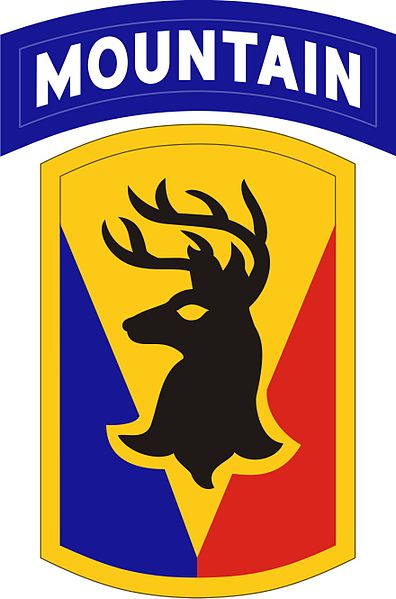
To streamline storytelling, details such as units and dates are not always emphasized strongly, and viewers are left to piece together some details for themselves. In the Kalagush episode, the distinctive "deer head" shoulder patch of the 86th BCT is plainly visible, as is the fact that the soldiers are wearing Universal Camouflage Pattern (U.C.P.), rather than the MultiCam pattern uniforms issued to soldiers rotating into theater later in 2010.

The episode depicts an attempt to root out enemy fighters who were then regularly harassing FOB Kalagush in nighttime attacks. One such attack hit a fuel tanker, causing a fiery explosion.

The Connecticut unit decided to take the fight to the bad guys. After dismounting a daytime patrol of foot soldiers in the vicinity of Wadawu village, however, the armored trucks came under fire from three elevated positions.

One driver, Spc. Kyle Schipritt, was outside of his vehicle when a rocket-propelled grenade hit. Despite his injuries, he sprinted back his vehicle and was able to maneuver his truck. Spc. Ernesto Gonzalez engaged targets via the truck's remotely operated gun system.

From his deployment, Shipritt received multiple awards of the Purple Heart, and an Army Commendation Medal for valor.

"Luckily, we were all behind rocks, so we had cover and concealment," says Sgt. Michael Finnegan, leader of the dismounted patrol. "But the guys down below, in the trucks? They didn't have any cover and concealment. They were sitting ducks. They had to get out of there." The trucks returned to base with the wounded, leaving the Finnegan's patrol to walk 7 hours along a ridgeline back to Kalagush.

A 3-minute excerpt of the Kalagush episode is available on the National Geographic Channel website here. The episode will again air in its entirety on Aug. 19, 8 p.m. CDT.

Another "Eyewitness War" episode, "Bomb Squad Booom," involves a combat engineer platoon conducting mine-clearance operations in the vicinity of FOB Mehtar Lam, Laghman Province. (FOB Mehtar Lam is connected by road to FOB Kalagush.) The episode is scheduled to air again Aug. 12, 8:30 p.m. CDT.

For a full listing of "Eyewitness War" episode times and dates, click here.

The National Geographic Channel is also currently broadcasting a number of other war-related documentary series, including "Battleground Afghanistan" and "Inside Combat Rescue."

Recent feature-length National Geographic documentaries include "Inside the Afghanistan War" and "Bomb Hunters Afghanistan."

01 February 2012

Hometown News ... from Downrange

Love it or hate it, a deployment turns an overseas patch of dirt into something akin to a high school, or a hometown. You spend a lot of time on the same ground, with the same people, doing a job that no one understands, speaking jargon and language foreign to anyone who doesn't wear the same uniform. There are inside-jokes, pep rallies, and lots of rules to follow. Some bonds are made, some friends are lost. Then, one sudden day, you leave.

Everyone leaves it behind, but everyone deals with it differently. Some people want to forget it all. Some people can't help but remember. Some people want to relive the stories of glory and war, over and over again.

Still others try to hold on in a different way, and keep an ear tuned to what's happening back in the old neighborhood. If you've ever wondered whatever happened to the star quarterback, the class clown, or the prom queen, you know what I'm talking about.

So it is with me. In 2003, I deployed to Egypt as part of a multinational peacekeeping force. I saw a lot, learned a lot, made a lot of friends. I had experiences I would have never had unless I'd joined the Iowa National Guard. Ever since, I have had an interest in political and cultural happenings there. I didn't realize I was so transparent until my grade-school daughter started checking out library books on ancient Egypt, and the lives of children who live there today.

"Someday, Daddy, can we go to Egypt together?" she often asks me.

Inshallah, Sweet.

The National Guard is something of a small community, too. There are interstate rivalries, to be sure, and occasionally quirky differences in character and capabilities. Given that the National Guard is now considered part of an "operational" reserve—one routinely called upon to augment active-duty forces—rather than as a "strategic" one of last national resort, keeping track of which brigade is doing what mission has become a little like following hometown sports.

Readers of the Red Bull Rising blog, for example, will remember that the Iowa National Guard's 2nd Brigade Combat Team, 34th Infantry "Red Bull" Division (2-34th B.C.T) was the second U.S. National Guard brigade ever to deploy to Afghanistan as a "battlespace owner"—and the first to be configured for that mission from the start.

Following the Red Bull is one of the reasons I continue to take an interest in all things Afghanistan. And Iraq.

In 2009-2010, Vermont's 86th BCT had successfully transitioned from its role as the headquarters of Combined Joint Task Force Phoenix to become a battlespace owner.

Currently, Oklahoma's 45th Infantry "Thunderbird" BCT is in Eastern Afghanistan, operating on some of the same ground as their Vermont and Iowa predecessors.

In 2011, another Red Bull brigade—the Minnesota National Guard's 1-34th BCT—deployed to Kuwait and Iraq. At the last minute in 2011, some elements of Oklahoma's 45h BCT were diverted to Kuwait to serve alongside the Red Bull. After U.S. troops left Iraq in December 2011, the Red Bull remains in Kuwait to serve as part of a 15,000-soldier regional reserve.

Jonathan Raab is a New York National Guard soldier currently on his second deployment. In 2011, New York's 27th Brigade Combat Team had been preparing for deployment to Afghanistan. The brigade went as far as the National Training Center, Fort Irwin, Calif., before taking an unprecedented pause over the December holidays. Thousands of citizen-soldiers were caught in a limbo between mobilizing and deploying. As Raab wrote in a December 2011 essay published by Stars and Stripes:
They told us we were not going to Afghanistan, but that we might go elsewhere. The new rumored deployment date was far enough down the road that I’d run out of money well before then; I had just enough time to find a new job or a new place to live, to get settled back in with my friends, family and girlfriend, and to get on with life before having to let go of everything and everyone all over again.
Raab has since learned he will deploy not to Afghanistan, but to Iraq, in a mission similar to that currently performed by the Red Bull and Thunderbird soldiers there. Raab has a blog called "With a Bible in My Ruck," which I hope will continue. Consider this recent excerpt:
This is a non-combat mission. We'll be training and pulling guard duty for a year. Am I happy that my comrades won't be coming home killed or maimed? Yes, praise God for that. But as an infantryman and a soldier, I can't help but feel like I don't have utility in a peacetime mission. I feel unnecessary. I feel like I'll be in football practice for a year with no chance to get in on the game. That's irrational, I know. But there it is.

I wouldn't be honest with you if I told you that I wanted to go at this point. My article in the Stars and Stripes 'Ruptured Duck' Blog sums up how I feel about the situation and its uncertainty. Ever since we were cut loose in November, I used that time to find work and plan for my life. With this deployment, however, that's over. I'll be going overseas for a mission that I did not want or volunteer for, and I'll be returning to an even more difficult job market.
For more official detail on missions and units comprising the 27th BCT deployment click here.

In yet another sign that the National Guard fight is changing in Afghanistan, Arkansas' 39th BCT was recently notified that its pending deployment has been cancelled.

Deployed with the Ohio National Guard's 37th Infantry "Buckeye" Brigade Combat Team (I.B.C.T.), "Old Blue" is a senior non-commissioned officer (N.C.O.) with 29 years of experience. He's on his third deployment to Afghanistan, and his third military blog, "Afghan Blue III."

He's previously served as a trainer with Afghan National Police (A.N.P.) in Kapisa and Nuristan Provinces. He's also had eyes on Helmand Province in Southern Afghanistan, where he worked with British soldiers.

Like Raab in Kuwait, Old Blue has found himself pursuing a different mission than the one for which he and his buddies had prepared. The brigade to which he is assigned will not be conducting "full-spectrum operations"—a term that includes everything from humanitarian assistance to finding and killing bad guys—but will instead be performing "security force assistance" (S.F.A.)—advising and resourcing their Afghan counterparts. (It could be worse/better: Some Buckeye soldiers were diverted to Bahrain.) Still, he is a believer in counterinsurgency ("COIN"), and sees his new role as part of a process. He writes:
My quest in Afghanistan parallels my nation’s quest; finding a new role in an increasingly globalized world. [...] [I]f the United States can assume the role of mentor, advisor and enabler of development, perhaps future conflicts can be avoided altogether. Insurgencies can be avoided and terrorism prevented from developing.

In the meantime, I will do what I can to help speed success in Afghanistan. I believe that success can best be accomplished through the adaptive and intelligent practice of population-centric counterinsurgency.

I am the father of four children; two girls and two boys. I live in Cincinnati, Ohio. My intent is that someday my children will visit Afghanistan as tourists, not as soldiers.
Inshallah. And roger that.

*****

Both the "With a Bible in My Ruck" and "Afghan Blue III" blogs have been added to a "News & Views from Downrange" blog-roll on the right-hand side of Red Bull Rising. Both writers have also been featured on Garry Trudeau's/Doonesbury's "The Sandbox." If you know of other blogs written by citizen-soldiers currently downrange, please recommend them to: sherpa AT redbullrising.com.

20 January 2012

2012 Condition of the Iowa Guard Speech

Echoing the tradition of the U.S. presidential "State of the Union" address to Congress, the state of Iowa engages in a series of annual speeches from various governmental leaders. The best known is the governor's "State of the State" address—now more likely called the "Condition of the State" in public and in the press—to Iowa legislators. The state supreme court justice annually delivers a "Condition of the Judiciary" speech. In what may be a practice unique to the Hawkeye State, the highest ranking officer of the Iowa National Guard delivers a "Condition of the Guard."

In 2011's Condition of the Guard address, Maj. Gen. Timothy Orr spoke of more than 3,000 Iowa National Guard soldiers deployed to Afghanistan and elsewhere. Those soldiers included the 2nd Brigade Combat Team (B.C.T.), 34th Infantry "Red Bull" Division (2-34th BCT) and the 734th Agri-business Development Team (A.D.T.). Orr is the adjutant general of the state of Iowa, and a former commander of 2-34th BCT. In this week's 2012 address, Orr reported that, for the first time since 2001, most of the Iowa National Guard's approximately 10,000 soldiers and airmen had returned home.

Orr also talked about the National Guard as a cost-effective supplement to active-duty military forces, celebrated developing state military partnerships with Kosovo, and pointed to employment and education efforts that support citizen-soldiers and veterans.

The complete text of Orr's Jan. 18, 2012 address appears below.

****

'PERFORMANCE AND PROMISE OF OUR HOMETOWN MILITARY – THE IOWA NATIONAL GUARD'

It is indeed an honor and a privilege to be here today and report on the condition of our Iowa National Guard, an organization that continues to be “Mission Focused and Warrior Ready.” With the exception of about 90 soldiers and airmen who are currently mobilized as individual deployers, nearly all of our personnel were home for the holidays. And for the first time since 2001, I can report the Iowa National Guard does not have any units currently deployed overseas.

Last month, the final contingent of American soldiers departed Iraq, bringing to a close this extraordinary chapter of American military history. As in previous military campaigns and conflicts, the Iowa National Guard played a prominent role and served with honor and distinction.

I am so proud of those who served and sacrificed in Operations Iraqi Freedom and New Dawn. They helped liberate and secure a country and gave hope to millions of Iraqis. Getting to this day was not easy. It tried our political and military leadership in ways unseen since the challenges of Vietnam. Despite these extraordinary circumstances, the men and women who served there did not falter. They carried out their duties day-in and day-out, many on multiple deployments, to ensure mission success.

Company B, of the 2-211th General Support Aviation Battalion, our last Iowa National Guard unit deployed to Iraq, returned home in November after flying more than 7,100 hours in support of Operation New Dawn. As the last CH-47 "Chinook" helicopter unit in Iraq, Company B played a critical role helping to remove personnel and equipment in support of the President’s efforts to have all American forces out of Iraq by the end of 2011, transporting 49,000 passengers and over four million pounds of cargo and equipment on more than 1,800 missions.

We thank the more than 7,000 Iowa National Guard soldiers and airmen who served in support of these operations. And to their families who sacrificed in order that our Warriors may serve, we are eternally grateful for all they have done and endured.

Success in Iraq came with a heavy price. We will always honor and remember the brave Iowa National Guard warriors we lost there, our Gold Star families, our wounded warriors and all those whose lives have been forever changed by the adversity of war. We are grateful that so many were willing to serve and sacrifice in spite of these challenges. It is a testament to the character and values of the men and women who serve our state and nation in uniform.

I am so incredibly proud of our Iowa National Guard family—our soldiers, airmen, families, employers, volunteers, and our communities. We owe them a huge debt of gratitude for all they have done to make a difference in this noble endeavor.

The deployments of the last 10 years were unprecedented in recent memory as nearly 15,000 Iowa National Guard soldiers and airmen mobilized for overseas contingency operations. These missions demonstrated the performance and promise of the Iowa National Guard which is truly your hometown military. Tough, reliable, resilient, adaptable and above all, ready when called—the Iowa National Guard played a vital role in helping defend the Nation during a critical time in our history.

Though busy overseas, we did not lose sight of our most critical mission—homeland defense and support. In fact, we responded to numerous disasters both here in Iowa and across the country that were often exceptional in both size and scope. In doing so, we fulfilled our statutory and constitutional responsibilities to help defend the nation and provide the governor with a state emergency response force.

We are able to protect communities here in Iowa and help defend the United States overseas for approximately one-third the cost of active-duty soldiers and airmen, making the National Guard the “best value for America.”

Two weeks ago, President Obama outlined his Defense Strategic Guidance for sustaining U.S. global leadership in the 21st Century. Based on this guidance, U.S. defense priorities are being reviewed. Part of this process will include looking at the mix of active and reserve component forces. In doing so, we must ensure the National Guard continues to play a vital role as an operational complement to our active duty services.

The most logical option for the nation to preserve its military capability, capacity and depth in times of fiscal constraints is through continued reliance on the National Guard. To do this, the National Guard must remain a modern force, capable of rapidly mobilizing, deploying and integrating into ongoing and future contingency operations.

Since the founding of our republic, the United States has been and continues to be a “militia nation.” This tradition is embedded in our culture and enshrined in our Constitution. With the exception of the large standing military necessitated by World War II and the confrontation with the Soviets during the Cold War, we have traditionally maintained a small active duty force backed up by a strong militia, the successor of which is today’s National Guard.

We are fortunate that [Iowa] Gov. [Terry] Branstad currently serves as the co-chair for the President’s Council of Governors. The council provides a forum for governors to exchange views, information or advice with the Department of Defense, Homeland Security and other federal agencies concerning matters of mutual interest regarding National Guard, homeland defense and civil support activities. This council is intended to strengthen the partnership between the federal, state and local governments to better protect our nation, and provide governors, who serve as the commander and chief of the individual state National Guard forces, a voice in the process.

One way we hope to support and adapt to the changing environment is through the National Guard’s State Partnership program (SPP). The March 2011 selection of the Iowa National Guard with the Republic of Kosovo, as the newest state partnership program in the National Guard, will enhance civil and military relationships and strengthen partnership capacity between the United States and Kosovo. The current focus of the program is on noncommissioned officer and officer development activities as well as cooperative initiatives in the disaster response and emergency management arena.

Partnering with Kosovo is a natural fit for the Iowa National Guard and the state of Iowa. Our relationship with Kosovo is not new, over the course of the last 10 years we have deployed hundreds of Iowa National Guard soldiers there as part of NATO’s peacekeeping security force. The most recent unit, Company C, 2nd Battalion, 147th Aviation, returned home from Kosovo in April, where they successfully flew more than 150 missions supporting 15 different NATO countries. One of their greatest accomplishments was building strong relationships with Kosovo communities by providing English instruction to local students and helping them with college entrance requirements.

Our goal is to build a “Whole of Iowa” to “Whole of Kosovo” relationship. An example of this approach would be in the area of education where the state of Iowa is a national leader. The Iowa-Kosovo SPP is off to a fast and productive start with engagements with the Kosovo Security Forces, Kosovo’s minister of Defense, Foreign Affairs, Internal Affairs, Agriculture, Health and Education. We currently have conducted over 12 exchange events with Kosovo since March 2011.

One of our near-term goals is to establish a sister-state relationship and foster several sister-city relationships to further enhance this partnership. Working with our communities and the Iowa Sister States’ program, we want to establish relationships that will be of mutual interest to the citizens of Iowa and Kosovo.

Today, I am pleased to introduce Maj. Gen. Kadri Kastrati, the commander of the Kosovo Security Force, who is with us this morning as my honored guest. I asked him to be here today to help highlight this critically important relationship, observe our legislative process and meet some of our key leaders.

Please join me in giving Gen. Kastrati a warm Iowa welcome.

Gen. Kastrati, thank you for making this journey to join us here today. We are honored to be partnered with Kosovo and we look forward to a strong and productive relationship in the years ahead.

Since its inception in 1989, the Iowa National Guard’s Counter Drug Task Force, which is federally funded through the Department of Defense, has played an important role in helping reduce both the supply and demand of illicit drugs in the state of Iowa. It adds value to our communities by making them safer, leverages unique military skills and dual-use equipment, and serves as another example of the performance and promise of your hometown military.

By providing professional, military analytical support to federal, state and local law enforcement agencies throughout the state, we have assisted with thousands of cases leading to nearly 1,700 arrests and the seizure of over $38 million in illicit drugs as well as more than $1.7 million in cash and assets. Our Counterdrug Aviation Detachment helicopter support section provides aerial reconnaissance and surveillance, integration, and command and control to support law enforcement drug interdiction efforts.

The Midwest Counter-Drug Training Center, located on Camp Dodge, provides critical training at no cost to law enforcement officers, military personnel, and prevention and treatment professionals. Last year, the Midwest Counter-Drug Training Center conducted 340 courses, training over 13,000 students from across the United States. This program is especially important for small or rural law enforcement agencies that do not have the funding to pay for this type of training.

A year and a half ago, we deployed nearly 3,000 Iowa National Guard soldiers from every corner of the state to Afghanistan for our largest deployment since World War II. This deployment, which took nearly one-third of our force, was a tremendous undertaking for our entire organization. We pulled soldiers and units from across the state to augment the 2nd Brigade, [34th Inf. Div.], relied heavily on our state headquarters and other supporting commands to assist with mobilizing soldiers, moving equipment and taking care of families while their loved-one was away. It was truly a statewide effort.

The 2nd Brigade, [as] Task Force Red Bulls, conducted a complex mission in a very challenging part of the world. For only the second time in recent memory, a National Guard brigade combat team assumed responsibility for “battlespace” in Afghanistan. From the relative peace of Panjshir province, to the complex operations of Bagram Air Field and the instabilities of Laghman Province, Iowa National Guard Soldiers distinguished themselves in accomplishing their mission.

They participated in one of the largest airborne assaults and clearing operations conducted by the 101st Airborne Division, doing so without suffering any battlefield injuries. They established a new district center in the Galush valley bringing security and government services to a remote population threatened by Taliban insurgents.

They hunted down and removed high value targets from the battlefield, helping to lessen roadside bomb and rocket attacks on our forces. They worked to train Afghan soldiers and police officers, doing so with the unique skills that only a citizen-soldier can provide.

With only a few hours to prepare, they flew into a dangerous corner of Nuristan Province with their Afghan National Army partners to reclaim a police station overrun by Taliban insurgents. Though outnumbered, these Red Bull soldiers fought off a determined enemy force for more than eight hours. Reinforced by U.S. Special Forces and Afghan Commando elements, they retook the district center, and suffered no friendly casualties.

When the call came out to secure a downed helicopter, it was Iowa Red Bull soldiers who responded, helping to stop insurgents from overrunning the crash site and allowing friendly forces to recover the crew.

And perhaps most importantly, TF Red Bulls led the way in developing transition plans for much of its area of responsibility including Panjshir and Parwan Provinces as well as the Mehtar Lam municipality. These were critical steps in preparing these areas to assume greater responsibility for their own security, development efforts and governance.

While Task Force Red Bulls was securing its corner of Afghanistan, the 734th Agri-business Development Team, also known as Task Force Hawkeye, was busy conducting operations in Kunar Province. This joint Iowa Army and Air National Guard team initiated or expanded demonstration farms in six different districts; they implemented Veterinary Outreach Sustainment Programs which helped Afghan veterinarians treat nearly 40,000 head of livestock; they underwrote the planting of more than 70,000 trees for orchards and reforestation; they facilitated, or conducted training of hundreds of Afghan men and women on tree nurseries, orchard planting, greenhouse growing, row crop production, veterinary professional development, and basic livestock care; they funded cash-for-work canal cleaning projects that made possible the irrigation of thousands of acres of agricultural land; and through their Female Engagement Team launched a range of micro-entrepreneurial projects for Afghan women including soap-making, in-home sewing and small-scale poultry production.

Because of the unique nature of the Ag Development Team’s mission, several Iowa organizations provided support to their deployment by assisting them with pre-mobilization training and reach-back capability while they were in Afghanistan. I want to mention and thank the following organizations for their assistance and support to this important mission:
The 132nd Fighter Wing was also busy supporting overseas contingency operations. They provided five, F-16 aircraft and 54 airmen to assist another fighter wing with its Air Expeditionary Force rotation to Afghanistan and sent 34 expeditionary combat support airmen to 11 locations in Southwest Asia.

This past year, the wing flew more than 3,700 hours, which is 103 percent of their allocated flying hours, doing so with the lowest funded maintenance package in the Air National Guard. Because of this, they have the second lowest cost per flying hour compared to all ANG F-16 units and are the only Air National Guard wing to reduce energy costs four straight years. Perhaps most impressive and important is their safety record. They have amassed a phenomenal record of nearly 94,000 flight hours without a serious mishap and have one of the best maintenance groups in the Air Force as demonstrated by winning the 2011 Air National Guard Maintenance Effectiveness Award.

The Des Moines Airbase’s 132nd Distributed Training Operations Center provides daily tactical Distributed Mission Operations training events on 18 types of weapons systems to nearly 70 different sites across the country. Last year, this one-of-a-kind capability supported 4,700 events, trained 9,600 war fighters and fulfilled over 20,000 training requirements, providing a significant cost savings to the Department of Defense training budget.

In Sioux City, the 185th Air Refueling Wing built on its outstanding record by winning the Airlift Tanker Association's Maj. Gen. Stanley F.H. Newman Award for being the best tanker wing in the country.

They deployed 370 airmen in support of contingency operations at 24 overseas and two stateside locations including two simultaneous deployments to Al Udeid Air Force Base in Qatar and Anderson Air Force Base in Guam. As one of the first Air National Guard units tasked to support hostilities occurring in Libya, they flew nearly 590 hours during 65 missions in which they provided more than two million pounds of fuel to aircraft supporting Operations Odyssey Dawn and Unified Protector.

They conducted three, two-week Aero-Medical Evacuations missions out of Bagram Air Field. helping to evacuate 177 wounded warriors from combat operations in Afghanistan. They also flew three air evacuation missions stateside, safely transporting 75 critical care patients throughout the United States, and executed seven missions in the Pacific theater evacuating more than 100 injured patients from that area.

While we are grateful so many of our Iowa National Guard Warriors have returned home after a busy year of deployments, we must not forget those still recovering from injury or illness related to their mobilizations. More than 100 of our wounded warriors are still receiving medical care, either at military treatment facilities across the country or from health care providers in their local communities. For us, these deployments are not truly over until the last of our wounded Warriors return home. It is our solemn obligation to keep faith with those who served and sacrifice and ensure they receive all the support and assistance they require.

On the domestic response front, we provided Iowa National Guard assistance to combat unprecedented flooding along the Missouri river. While not our largest state response mission, it was by far our longest, lasting more than 100 days. During the course of this emergency, we put nearly 1,000 soldiers and airmen on State Active Duty to assist.

Starting in May, we provided a UH-60 “Blackhawk” helicopter through a mutual-assistance mission to help local authorities place large sandbags in the Dakota Dunes area of Southeastern South Dakota.

In support of the Homeland Security Emergency Management Division, we set up a Joint Task Force and dispatched Iowa National Guard alumni to coordinate with county-level civilian emergency managers and officials. We also dispatched Critical Infrastructure Assessment Teams, which consists of uniformed National Guard personnel familiar with civil constructions topics, to provide assessments on ongoing infrastructure issues.

Starting June 4, levee breaches in Missouri required the mandatory evacuation of 600 citizens from Hamburg, Iowa. We provided helicopter support to place sandbags to shore up the failing levees. On June 10, we provided Iowa Air and Army National Guard personnel to monitor levees in Sioux City and Pottawattamie and Mills Counties. By the mid-August operational peak, we had approximately 284 Guard members on duty to support civil flood response efforts. When five inches of rain and hail in the Council Bluffs area caused local flooding, we provided six high-water tactical vehicles to assist with emergency rescue operations, helping to evacuate 24 children from a school bus stalled in four feet of water, as well as seven people and two pets.

One reason we’ve been able to maintain our position as a national leader among our fellow states is because of our National Guard Educational Assistance Program (N.G.E.A.P.). This critical recruiting and retention tool helps ensure our readiness. Without it, we couldn’t have mustered the necessary personnel to meet all of our overseas and in-state mobilization requirements over the last 15 years. NGEAP is also a great benefit to our soldiers and airmen. Each year approximately 1,100 to 1,200 of our members attend Iowa colleges and universities through this program. It keeps young people here in the state and through their service in the Iowa National Guard helps deepen their Iowa roots. We greatly appreciate the assistance provided by the Governor, the legislature and the Iowa College Student Aid Commission to ensure we help to meet the education needs of our Iowa National Guard Warriors in exchange for their service to our state.

Most of our members come back from deployment and return to what they were doing before they left. They return to work, go back to the farm, enroll in school or pursue new opportunities. However, some find this transition difficult. They may have been unemployed or underemployed before deploying or returned to find their positions eliminated due to the economic downturn. Others may simply want a new challenge after their deployment experience. Whatever the reason, nearly 10 percent of our returning Warriors are looking for work. And we have an obligation to help.

Working with the Employer Support of the Guard and Reserve (E.S.G.R.) and our Job Connection Education program, we are actively working to assist our soldiers, airmen and their spouses to find gainful employment. We have partnered with Iowa Workforce Development and local human resource management groups to assist our members. Through this process we have developed a one day course designed to assist returning service members searching for work. We assist them with writing resumes and cover letters in order to translate their military experience into meaningful civilian skills. We work on interviewing techniques and practice interviewing skills and we prepare them for job fairs.

Through our partnerships with Iowa Workforce Development, we have placed computers kiosks in our armories to assist our members with finding and applying for job openings. Last October we supported with other state and federal agencies a veterans’ job fair and have begun posting job openings, targeting veterans on websites like the National Guard’s Jobs Connection Education Program and Employer Partnership.

Despite our largest deployment since World War II and the lengthiest state mobilization in recent memory, the Iowa National Guard continued to demonstrate the performance and promise of your hometown military. Regardless of the challenge, we will remain “Always Ready and Always There” for the citizens of our great state and the defense of America.

The future remains uncertain. As the challenges of the last 10 years fade, new ones are sure to emerge. Budget constraints and shifting priorities will impact how we operate and what we are asked to do in the years ahead. Despite these challenges, the Iowa National Guard will remain “Mission Focused and Warrior Ready.”

On behalf of our soldiers, airmen and their families, I want to thank you for this opportunity to provide an assessment of the Iowa National Guard. We are so grateful for the continued support we receive from the general assembly, the governor, lieutenant governor, and the citizens of Iowa.

Thank you, ladies and gentlemen.

18 October 2011

'Ironman' Gunners Invent Ammo-Carrier

A team of Iowa Army National Guard "Red Bull" soldiers was recently credited with inventing a system that allows an individual to carry 500 rounds of belt-fed Mark 48 machine gun ammunition on his back, allowing him to provide sustained and deadly fire while on foot. Without it, a dismounted machine-gunner must be assisted by another soldier, who helps to carry equipment and ammunition, and to feed the weapon belts of bullets.

"When we first arrived in theater in late October [2010], we were issued the Mk 48 7.62 mm machine guns," said Staff Sgt. Vincent Winkowski in a recent Army news article. "This was a new piece of equipment for us, and we struggled to come up with a solution for carrying and employing ammunition for it, due to our small size and the inability to have a designated ammo bearer [...]

"The ammunition sacks that came with it made it too cumbersome and heavy to carry over long, dismounted patrols and especially when climbing mountains. Initially, we came up with using 50-round belts and just reloading constantly, which led to lulls of fire and inefficiency."

Winkowski, Spc. Derick Morgan, and Spc. Aaron McNew got the idea from the 1987 Arnold Schwarzenegger movie "Predator," in which actor, wrestler, and former Minnesota governor Jesse "The Body" Ventura wields a manpackable Minigun. McNew first employed the system in combat in February 2011.

The design is a mash-up of previously issued equipment: A rucksack frame, a couple of modified ammo cases, and a 27-inch feed-chute assembly (cost: $1,710) borrowed from a Common Remotely Operated Weapons System ("CROWS") vehicle mount. (A CROWS allows soldiers to aim and operate machine guns and other weapons with a videogame-like interface, while seated safely inside an armored vehicle.)

Army fabricators have dubbed the design for a high-capacity ammunition carriage system the "Ironman"--the traditional nickname of the Iowa Army National Guard's 1st Battalion, 133rd Infantry Regiment (1-133rd Inf.). The unit, as part of the larger 2010-2011 deployment of 2nd Brigade Combat Team, 34th Infantry "Red Bull" Division (2-34th BCT), returned to Iowa earlier this summer. Between October 2010 and July 2011, the 1-133rd Inf. operated in Eastern Afghanistan's Laghman and parts of Nuristan provinces.

According to the Army news release, improved prototypes were shipped downrange approximately 48 days after Army technicians inspected the Iowans' work. And, if budgets and manufacturing contracts allow, the Ironman system could be more-widely delivered to troops sometime in 2012.

"We've already gotten e-mail traffic from [one of] our science advisers that everybody in theater wants one of these--and by in theater, he means his specific area of operation, Regional Command East in Afghanistan--because word has spread," said Dave Roy, an operations analyst with Natick Soldier Research, Development and Engineering Center (N.S.R.D.E.C.). "That [Iowa National Guard] unit [was] not the only unit on [Forward Operating Base Mehtar-Lam]. As they're walking around the FOB with that piece of kit, very senior people are taking a look at it. They recognize it as a game-changer."

News of the Ironman ammo-carrier design was recently published on the Military.com website, as well as Wired's "Danger Room" blog.

21 December 2010

5 Books to Read About Afghanistan

Don't call this a Gift Guide, or even a "Best Books of Pre-Deployment" review. Reading these titles won't make you an expert on Afghanistan, or What We're Trying to Do There. That said, as a citizen-soldier, I've found each of these helpful in piecing together What We're Doing in Afghanistan.

Best of all, each of these is accessible to non-military audience. In other words, you don't have to be a military historian fluent in Army acronyms to get a lot of bang from these books:

"War" by Sebastian Junger

This book covers much of the same ground as the 2010 documentary "Restrepo," which author Sebastian Junger ("The Perfect Storm") co-produced with Tim Hetherington after continually embedding with a U.S. infantry company in Afghanistan's Korengal Valley in 2007-08. I saw Restrepo first, and even been lucky enough to have seen it a couple of times. The book enriched my understanding not only of how the soldiers of Battle Company, 2nd Battalion, 503rd Infantry Regiment, 173rd Airborne Brigade Combat Team fought the fight, but how they came to the fight in the first place--and where it left them afterward.
  • First impression on reading the book: "Wow! That was ... Wow!"
  • Second impression: "I can't wait to read that again!"
  • Third impression: "I can't wait to see 'Restrepo' again!"
I've decided to start describing Junger's book as one facet of a larger multimedia work, one that needs to be visited and re-visited, turned over and reflected upon. Yes, each of the components--"Restrepo," Junger's "War," and Hetherington's "Infidel" (reviewed below)--is independently worthy of much praise and consideration. They add up to something even greater, however.

For his part, Junger makes writing about war look almost too easy. One can spend hours unpacking his simple prose, as if the sentences were written by Confucian fortune-cookie makers. Here are some personal favorites or mine:
Every time you drove down the road you were engaged in a twisted existential exercise where each moment was the only proof you'd ever have that you hadn't been blown upon the moment before. [p. 142]

Rear-base limbo: an ill blend of apprehension and boredom that is only relieved by going forward where things are even worse. [p. 199]

When I asked the men about their allegiance to one another, they said they would unhesitatingly risk their lives for anyone in the platoon or company, but that the sentiment dropped off pretty quickly after that. By the time you got to the brigade level--three or four thousand men--any sense of common goals or identity was pretty much theoretical. [p. 242]
*****

"Infidel" by Tim Hetherington

Packaged to resemble the type of black Moleskine sketchbook favored by some artists and writers, this collection is a jumble of Hetherington's photographs, words from soldiers and Sebastian Junger, and other mental ephemera.

Hetherington's photographic view extends to a more-artistic, less-journalistic treatment of some of his subjects. Sometimes, rather than a straight-forward newshound's pictorial account of soldierly toil, Hetherington gives the grime and squalor a near-transcendent treatment--combat as still-life. Trust me: After reflecting on these images, you will never look at fly-strips, Army cots, and cheesecake centerfolds the same way.

The book takes its title from one of the tattoos shared by the Battle Company soldiers. (One of the soldiers packed a tattoo gun up to the remote outpost.) Hetherington documents the body art in both photographs and drawings. Each soldier has his own designs, his own scars, and his own brand--variations on a theme.

If "Restrepo" allows us to witness the conditions that Battle Company endured, and "War" illuminates how fighting men are bound together, then "Infidel" allows us to see each of these men again as individuals: flawed, young, and innocent.

As Junger writes in Infidel:
Creeping through the outpost came Tim, camera in hand, grabbing photographs of the soldiers as they slept "You never see them like this," he said to me later. "They always look so tough, but when they're asleep they look like little boys. They look the way their mothers probably remember them." [p. 15]

Having seen the war through Hetherington's eyes, you will not look at your sleeping sons and daughters the same way, either.

*****

"Where Men With Glory" by Jon Krakauer

I'm not sure I would've liked Pat Tillman. That's probably saying more about me than it is him, but more on that in a second. In the mid-1990s, Tillman played college football for Arizona State University, and eventually ended up playing professionally for the Arizona Cardinals. After the terrorist attacks of Sept. 11, 2001, however, he and his brother enlisted in the Army--he gave up millions of dollars to serve his country--and later deployed to both Iraq and Afghanistan.

I tend to be biased against jocks and meatheads, and pictures of Tillman as the square-jawed Army Ranger or the long-haired gridiron gladiator tend to play into my worst high-school instincts.

The problem is, Tillman doesn't fit anybody's stereotype. And he was anything but a meathead.

As he was an everyday free-thinker, iconoclast, and patriot, I probably would've ended up liking Tillman, if I had been given a chance. Unfortunately, too many of us were never given the chance. He was killed in Khost Province, Afghanistan in a friendly fire incident April 22, 2004.

In the United States, political and Army leaders at the highest levels sought to celebrate Tillman as a martyr in the "Global War on Terror," a position at odds not only with the circumstances of his death, but with his increasingly articulated views against the invasion of Iraq.

The events leading up to Tillman's death were largely driven by bad calls made by unthinking leaders who were back in a Tactical Operations Center ("TOC"), rather than out on the ground. Army leaders failed to investigate and accurately report those events. Tillman's death was used for cheap political gain.

Ask any soldier: Accidents can happen--even fatal ones--but cover-ups are made. Cover-ups are more insidious than friendly fire. Cover-ups chip away at trust and honor within an organization. If we don't have trust and honor, what are soldiers left with? And what good is an Army?

*****

"Afghan Journal" by Jeff Courter

I reviewed this book in June, and had the pleasure of working with the author when he guest-blogged for Red Bull Rising in November.

Illinois Army National Guard Sgt. First Class Jeff Courter weathered a 2007 deployment to Afghanistan with plain-spoken good humor, quiet faith, and a passion for trying to put it all together. A former Marine cook and Navy Reservist, he deployed to Afghanistan as as an Army ETT tasked with training Afghan Border Police (A.B.P.). While there, he blogged about his experiences, and later self-published this book. His blog-posts are presented here chronologically, which creates a conversational, easy-to-read pace.

When a National Guard mother or father asks me about what the Afghan mission is like and for, I often start by putting Courter's book in their hands.

*****

"Greetings from Afghanistan: Send More Ammo" by Benjamin Tupper

Reviewing this book was one of the first good things I did shortly after launching the Red Bull Rising blog in December 2009.

New York Army National Guard Capt. Benjamin Tupper had worked in Afghanistan as a civilian in 2004 before deploying as an Embedded Training Team (E.T.T.) member in 2006. An ETT is a small group of U.S. soldiers who train and mentor Afghan police and army counterparts. As such, they're really the less-celebrated core of the U.S. military mission in Afghanistan. You can kick down as many doors and kill as many bad guys as you want, but until the Afghan government can keep its own people safe and secure, it's all just tactical cats-and-mice.

As Tupper writes:
Sending an additional 30,000 soldiers may seem like a rational approach to fighting and defeating the growing Taliban insurgency, but it misses a simple truth. As the Afghans like to say: "You Americans have all the watches, but we Afghans have all the time."

16 September 2010

The Dirt Warriors from Iowa

Monday's Red Bull Rising post weeded through some Army acronymns related to the "advise-and-assist" mission in Afghanistan. Today, I'd like to drill down into one of these missions, the Agriculture Development Team (A.D.T.), also sometimes called "Agri-business Development Teams."

According to Army literature, ADTs work with the provincial authorities to provide agriculture-specific training on:
  • Water and soil conservation and management.
  • Animal husbandry (goats, sheep, cattle, donkeys, and horses).
  • Orchard management (apples, peaches, almonds, apricots, etc.).
  • Alfalfa and wheat production.
  • Vegetable production.
  • Agriculture marketing.
  • Extension programs and education.
  • Irrigation techniques and efficiency.
There are currently nine ADTs in Afghanistan, including a group of Iowa National Guard soldiers and airmen deployed to Kunar Province in Eastern Afghanistan. The 734th Agri-business Development Team takes its formal name from the 734th Regional Support Group (R.S.G.), but has quickly re-branded itself the "Dirt-Warriors."

The ADT is keeping people back home well-informed via Facebook and other means. It's also had plenty of adventures already, including:
On their left shoulders, 734th RSG personnel wear the same "Hawkeye" patch worn by all Iowa Army National Guard soldiers not assigned to the 2nd Brigade Combat Team (B.C.T.), 34th Infantry "Red Bull" division. Recently, however, the Dirt-Warriors put on their right-shoulder "combat patches"--the "Screaming Eagle" of the 101st Airborne Division!