Showing posts with label connecticut. Show all posts

17 June 2015

Mil-poet Tells Stories Unique to Modern Minutemen

In 2006, Colin D. Halloran deployed to Afghanistan with the Connecticut Army National Guard's 1st Battalion, 102nd Infantry Regiment (1-102nd Inf.), a unit with a command relationship to Vermont's 86th Infantry Brigade Combat Team (86th B.C.T.). Among other missions, he and his fellow citizen-soldiers were assigned to provide security to the Provincial Reconstruction Team (P.R.T.) located at Tarin Kowt, Uruzgan Province.

(Apparently, he's also walked some of the same Afghan terrain as elements of Iowa's 2nd BCT, 34th Infantry "Red Bull" Division in 2010-2011. In "Tours," an 8-page essay that's one part prose-poem, one part fever-dream, and additional parts medical history and autobiographical sketch, he also mentions bouncing back and forth between Bagram and Kalagush.)

After Halloran suffered a blown knee and broken wrist while in Afghanistan, the Army couldn't decide whether or not to ship Halloran stateside. He eventually was returned to the states early, without his platoon-mates.

In 2012, Halloran published "Shortly Thereafter," a collection of poetry—sort of a "memoir in verse." The narrative arc of the 80-page book traces the entirety of the military experience—some "hooah" moments, but most others ranging from "aw, shucks" to "aw, sh--." Halloran notably gives voice and detail to the experiences of the citizen-soldier, those modern-day Minutemen and Minutewomen who leave civilian jobs and life to answer their country's call. These are the stories not often heard above the hype and glory reserved for snipers and SEAL teams.

Consider, for example, his opening poem "Foxtrot," an illumination of the civil-military divide as experienced on the college campus:
[...] I had the documentation,
the prof knew the situation,
but I guess I went against his politics.

So I went to war with an F in anthropology
and a form written will,
leaving what little I had in the hands of by brother,
and forcing me to spend what little downtime I could muster
between missions on global phone calls to university officials
so if I returned from the desert, rendered my will unnecessary,
there would be a black mark on my transcript.
There is bone and gristle and flesh in Halloran's writing as well, more than enough for the meat-eating mil-poetry crowd. He writes with skillful and gleeful precision, for example, about minutia and militaria such as grenades, radios, and Quick Reaction Force (Q.R.F.) duty. In "Mr. Shingles," he provides the following character study:
[...] The joys of being grenadier.
Six extra pounds of volatility.

5 meter kill radius. 15m CR.
These are the things you need to know.
Knowledge to be effective in the field.
Knowledge that one round to the chest
(a chest maybe 70% covered)
will take you and anyone unfortunate enough
to be in that CR.

Boom.
Given the circumstances of his final injuries downrange, Halloran's Afghan experience ends not with a bang but a solo flight outta Dodge. In his last poems, he wrestles, mostly alone, with the realities of home and coming home. Take "Hartsfield," for example:
Cane in hand, I disembark,
reentering the world I used to know. [...]

Pride—in what I've done.
Tears—for where I am. And what I've left behind. [...]
Homecoming is a journey, however, not a destination. Halloran's explorations of his wartime experiences are not complete. He has a second collection of poetry forthcoming this fall from Main Street Rag Publishing Co., Charlotte, N.C. In a quick e-mail note to the Red Bull Rising blog, Halloran says that "Icarian Flux" picks up where "Shortly Thereafter" leaves off: Using metaphor, persona, and narrative to explore his relationship with PTSD and those around him in the years following his deployment.

Based on the name-dropping present in the title of the work, as well as samples available at the Main Street Rag website, there's going to be lots of falling. And, one assumes, getting up. In "Self-Portrait as Icarus," Halloran writes:
If you can’t achieve greatness elsewhere,
find it in the fall

my next will be at night
not because of lessons learned
but because I want to see
the stars from the other side […]
For a limited time, the $14 book is available for pre-order for only $8. The book will be published in October 2015. For examples of his new work, click here.

"Shortly Thereafter" remains available via Amazon, local booksellers, and at discount directly from the publisher.

Bonus: Check out mil-blogger Peter Molin's ("Time Now") review of "Shortly Thereafter" here.

07 August 2013

Nat'l Geographic's 'Eyewitness War' Eyes FOB Kalagush

A recent episode of a National Geographic Channel television series focuses on familiar U.S. National Guard uniform patch, as well as a familiar patch of ground in Eastern Afghanistan.

In an episode titled "Mountaintop Revenge," the 30-minute program "Eyewitness War" depicts the May 2010 actions of a Connecticut National Guard platoon then based at Forward Operating Base ("FOB") Kalagush, Nuristan Province.

The platoon was part of Connecticut's 1st Battalion, 102nd Infantry Regiment (1-102nd Inf.), which deployed to Afghanistan as part of Vermont's 86th Brigade Combat Team (86th I.B.C.T.), approximately November 2009 to October 2010. At the end of its successful rotation, the unit was replaced by Iowa's 2nd Brigade Combat Team, 34th Infantry "Red Bull" Division.

Through helmet-camera footage, after-action interviews, and computer-graphic reconstructions, the "Eyewitness War" series tells stories of conflict in Afghanistan and Iraq as seen by personnel on the ground. Each program is introduced with the claim that "The footage you are about to see was shot by U.S. military personnel."

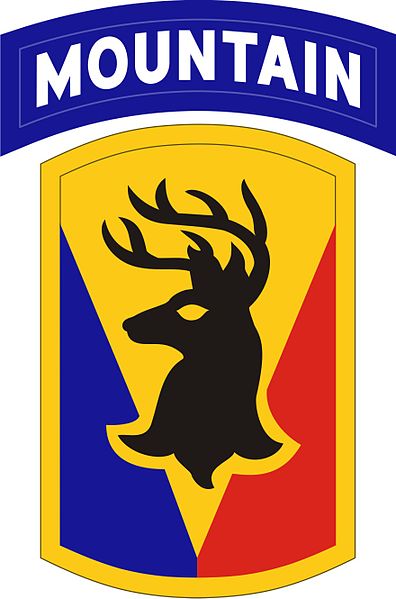
To streamline storytelling, details such as units and dates are not always emphasized strongly, and viewers are left to piece together some details for themselves. In the Kalagush episode, the distinctive "deer head" shoulder patch of the 86th BCT is plainly visible, as is the fact that the soldiers are wearing Universal Camouflage Pattern (U.C.P.), rather than the MultiCam pattern uniforms issued to soldiers rotating into theater later in 2010.

The episode depicts an attempt to root out enemy fighters who were then regularly harassing FOB Kalagush in nighttime attacks. One such attack hit a fuel tanker, causing a fiery explosion.

The Connecticut unit decided to take the fight to the bad guys. After dismounting a daytime patrol of foot soldiers in the vicinity of Wadawu village, however, the armored trucks came under fire from three elevated positions.

One driver, Spc. Kyle Schipritt, was outside of his vehicle when a rocket-propelled grenade hit. Despite his injuries, he sprinted back his vehicle and was able to maneuver his truck. Spc. Ernesto Gonzalez engaged targets via the truck's remotely operated gun system.

From his deployment, Shipritt received multiple awards of the Purple Heart, and an Army Commendation Medal for valor.

"Luckily, we were all behind rocks, so we had cover and concealment," says Sgt. Michael Finnegan, leader of the dismounted patrol. "But the guys down below, in the trucks? They didn't have any cover and concealment. They were sitting ducks. They had to get out of there." The trucks returned to base with the wounded, leaving the Finnegan's patrol to walk 7 hours along a ridgeline back to Kalagush.

A 3-minute excerpt of the Kalagush episode is available on the National Geographic Channel website here. The episode will again air in its entirety on Aug. 19, 8 p.m. CDT.

Another "Eyewitness War" episode, "Bomb Squad Booom," involves a combat engineer platoon conducting mine-clearance operations in the vicinity of FOB Mehtar Lam, Laghman Province. (FOB Mehtar Lam is connected by road to FOB Kalagush.) The episode is scheduled to air again Aug. 12, 8:30 p.m. CDT.

For a full listing of "Eyewitness War" episode times and dates, click here.

The National Geographic Channel is also currently broadcasting a number of other war-related documentary series, including "Battleground Afghanistan" and "Inside Combat Rescue."

Recent feature-length National Geographic documentaries include "Inside the Afghanistan War" and "Bomb Hunters Afghanistan."